However, the real story behind dream catchers is a little more complex. While some see it as a symbol of unity among tribes, others feel the dream catcher has become misappropriated and over-commercialized. Despite this polarization, the origins of the dream catcher and the beliefs surrounding it remain a fascinating part of American history. Shop for Dream Catchers in Wall Hangings. Buy products such as Heart Shape Handmade Dream Catchers with Led lighting Hand Made Wall Hanging Decoration Ornament Craft Gifts Perfect for Girls' Bedroom at Walmart and save. Dream Catchers: Dreamcatcher: Grandmother's Dreamcatcher: Illustrated instruction kit by a Navajo couple on how to build dreamcatchers. Beautiful picture book about an Ojibwa baby's dreamcatcher. Gentle story of a contemporary Chippewa girl learning the dream-catcher tradition.
- Real Dream Catchers
- Dream Catcher Weaving Patterns
- Real Dream Catcher
- Large Dream Catchers Native American
- Real Dream Catcher Near Me
- Dream Catchers Real Estate
Introduction to the Legend
Everyone dreams. Psychologists such as Sigmund Freud and Carl Jung have tried to interpret dreams and our subconscious thoughts. Though these modern scientists have provided multiple theories and vast quantities of written analysis, they are by no means the first to have taken on this eternal and elusive subject.
Dream interpretation has directly influenced Native American cultural and spiritual beliefs for centuries. American Indians believe dreams influence the conscious soul of the dreamer, oftentimes acting as a means for change in personality traits such as confidence, maturity, kindness, and loyalty.
Best Selling Dream Catchers
5 Dreamcatchers in One |
More About Dream Catchers
Dreams have always been a fundamental part of Ojibwe culture and have many purposes.
- Prophecies: Dreams can show future events that will affect a tribe or individual person.
- Names: Spiritual leaders can receive the name of a newborn child through dreams.
- Spiritual Strength: Many Ojibwe people pray, meditate, and fast in order to bring on dreams that will give them spiritual guidance during difficult times.
- Symbolism: Dreamers will often see a symbol that has personal meaning to them throughout their lives. Many Ojibwe make a charm to keep with them to remind them of the symbol. Some even take them to the grave when they die for strength in the afterlife.
The Ojibwe people, often referred to by their anglicized name, 'Chippewa', so insightfully understood the importance of dreams, especially in children, that they attempted to assist a child’s ability to receive good dreams and filter out dark or negative dreams with the use of a dream catcher.
What is a Dreamcatcher?

Frances Densmore, a renowned ethnographer who dedicated decades of her life to working with many Native American tribes, including the Ojibwe, wrote in her 1929 book, Chippewa Customs, about the longstanding existence of dream catchers:
Infants were given protective charms in the shape of “spiderwebs” that were hung on the hoop of a cradleboard. Traditionally, two spider webs were hung on the hoop, and it was said that they protected the child from harmful dreams and other dangers passing through the air.
In other words, a dream catcher would trap the bad dreams that blew freely in the night air and keep them from entering the mind of those it protected.
History of the Dreamcatcher
In her writings, Densmore dispels a common misunderstanding of the Ojibwe dream catcher by indicating that its purpose was to ensnare harmful influences in its web, thereby keeping them from reaching the dreams of children.
The Ojibwe people believe that the dream catcher’s web will trap bad dreams or dark spirits, thereby allowing the good dreams to escape through a small hole in the center and enter the child’s dream.
Beyond the protection and enhancement of children’s dreams, dream catchers were believed to have worked equally as effective for adults and families. Many Ojibwe lodges had a dream catcher hanging above the family’s sleeping area in order to filter bad spirits from all of their dreams.
As intermarriage and trade contact with other tribes increased, the concept of dream catchers spread to nearby tribes such as the Lakota who, over time, developed their own traditions.
In modern times, particularly during the American Indian Movement (AIM) of the 1960s and 1970s, when a pan-Indian mindset developed in the United States, many other tribes accepted the concept of dream catchers and incorporated them into their own cultures as a way of retaining traditional spirituality.
Today, only 40 years since the AIM movement took place, the common misconception remains that dream catchers have always been an integral part of most Native American cultures. But the truth is that mainly the Ojibwe people and Lakota were the early adopters and until more recently, were the only possessors of the traditional dream catcher.
Two Dreamcatcher Legends
Dream catchers have two legends about their beginnings; one told by the Ojibwe and another told later by the Lakota after they learned about them through trade and intermarriage with the Ojibwe people.
Ojibwe Legend
A grandmother watched patiently each day as a spider spun his web above her sleeping place until one day her grandson noticed the spider and tried to kill it.
“Don’t hurt him,” she told the boy in a soft tone, surprising him.
“But grandmother, you should not protect this spider.”
When the grandson left, the spider thanked the woman for her protection and offered her a gift. “I will spin you a web that hangs between you and the moon so that when you dream, it will snare the bad thoughts and keep them from you.”
At this, grandmother smiled and continued to watch the spider spin his web.
Lakota Legend
While receiving a spiritual vision high on a mountain, a Lakota leader met Iktomi, a trickster who also held great wisdom. Appearing to the leader in the form of a spider, Iktomi made a hoop of willow and spun a web inside of it.
He told the aged Lakota man that many forces, both bright and dark would attempt to enter peoples’ dreams and that the dream catcher he was making would catch the bright forces and allow the dark ones to slip away and burn up. Iktomi instructed the old man to make dream catchers for his people so they could all achieve a bright future by capturing the good dreams that are blown about by the winds of the night.
As you can see, in the Lakota version, dream catchers trap good dreams, just the opposite of the Ojibwe belief.
Design of the Dreamcatcher & What the Parts Mean
Once again we turn to Frances Densmore to learn about dream catcher design in ancient times. She writes “These articles…consisted of wooden hoops about 3 ½ inches in diameter filled with an imitation of a spider’s web made of fine yarn, usually dyed red. In old times this netting was made of nettle fiber.”
Nearly every part of a dream catcher had a meaning.
- Hoop: The wooden hoop was either circular or teardrop shaped. It served primarily as a frame for the web, but some believe it represents the circle of life.
- Web: The web, traditionally patterned after a spider’s web, was to catch bad dreams (good for Lakota) and keep them from entering the dreamer’s head.
- Feathers: Numerous purposes are assigned to feathers that hang from the hoop. Many believe they provide a soft ladder for the good dream to glide down and gently enter into the dreamer’s mind.
In more modern times makers have added other items to dream catchers.
- Beads: A single bead often represents the spider that made the web. Many beads or hanging beads can represent good dreams that trapped during the night.
- Gem Stones: Because it is illegal for most people to posses certain types of feathers, gem stones are now used to replace the symbolism feathers once held.
- Arrowheads: For increased strength and protection, some makers add arrowheads. For other, arrowheads point to the four corners of the earth, directions from which the wind blows.
Real Dream Catchers
Design Variations & Commercialization
Since the common acceptance of dream catchers in the 1970s, many variations have appeared. The end-point weave of a spider web pattern is now uncommon, giving way to mid-point weaves, loops, stars, and other decorative, frilly patterns. The traditional use of feathers and beads is still in practice, but the symbolism only remains in non-commercial uses.
Some Native American individuals and groups feel that the commercialization of dream catchers is an unfortunate misappropriation of spiritual traditions, while others actively engage in their manufacture and sale.
Marketing and mass-production methods have left customary materials at the wayside in favor of easily obtained supplies such as fishing line instead of nettle fiber, balsa wood instead of willow, and synthetic feathers and beads. Many non-Natives also produce and sell dream catchers, further confusing the item’s important spiritual traditions.
Protecting the Culture of Dream Catchers
Fortunately, the Indian Arts and Crafts Act of 1990 prohibits manufacturers from suggesting that their products are Native-made or have any connection with a Native American group unless they are “a member of any federally or State recognized Indian Tribe, or an individual certified as an Indian artisan by an Indian Tribe.” Furthermore, listing the tribal affiliation of the producer of the items is required. This, at least, will allow consumers to know if they are purchasing an Ojibwe, Lakota, Cherokee, or some other design of dream catcher.
Dreams of the Fathers
Despite the many styles available today, and notwithstanding the different versions of the origin of dream catchers, they are very popular across cultural boundaries. Perhaps this widespread acceptance is a symbol itself of the power of dreams to affect reality.
Dream Catchers | ||
The First of their Kind... | ||
Kokopelli style dream catchers to inspire you to awaken WITHIN the dream. Real lucid dream catchers for sale. | ||
MEDICINE WOMAN DREAM CATCHER | 3-D Anthropomorphic Beadwork - nothing like it anywhere! | WARRIOR DREAM CATCHER |
Dream Catcher Weaving Patterns
Lucid Dream Catchers for sale
The iconic Kokopelli often takes part in fertility rituals and marriage and is sometimes depicted with a consort, the female counterpart Kokopelmana (as called by the Hopi). Legend has it that Kokopelli can be seen on the full and waning moon. Likewise, the Kokopelmana may be described as a fertility goddess ensuring good crops and many children. The original Kokopelli of countless ages past, was depicted with an erect lingham but has been emasculated by our pious society, many whom have little knowledge of the esoteric powers represented by its symbolism.
Sky Dance Dream Catchers
These 5½' long (head-to-foot / about 17” total) Shaman Kokopelli dream catchers represent the sexual potency of lucid dreaming and the powers gained therein. Each Medicine Manikin is meticulously hand-crafted with care by the artist. They are strung with leather lace with wooden beads for hands and feet. He used imitation ivory and terra cotta beads for the belly and imitation antiqued bone beads for the upper torso and limbs. The gold Aztec Sun and silver Aztec Moon beads (both metal-plated plastic) are suspended with hemp cord and swing freely in the breeze. A mated pair of these dream catchers in a breezy window will make love. (Please allow for slight variations in bead color, feathers and feather mount beads: Form and quality are consistent with what are displayed here and guaranteed to please.) Be the first to own this new type of dream catcher!
Limited Quantity: One set of two per customer please.
$99.00 with FREE Shipping |
MEDICINE WOMAN DREAM CATCHER (Kokopelmana) |
The Medicine Woman’s head is imitation frosted crystal. Frosted quartz crystal pebbles are often found with Indian artifacts near rivers and are thought to be considered gems by early Indians. When wetted, they become clear. Likewise, when wetted with mindfulness, the mind becomes crystal clear with 360˚ awareness. Knowing that all is an illusion, she holds the Sun and Moon symbolizing complete oneness with the phenomenal world. Her lower belly bead is a flowering Tan Tien (third chakra, 3 finger widths below the naval) which is our center of gravity and the nexus for dream flying. It is the next power center routing upwards - tapped from sexual energy for bliss and groundedness. Her feet are hot* from dream flying as she rises to become a “Dakini” (Tibetan Buddhist female sky dancer). This Sky Dance Dream Catcher comes topped with an American Ringtail Pheasant tail feather. The Ringtail symbolizes inner beauty and abundance. The ultimate Dream Catcher... Hang from an open window in gentle breeze and watch her sky dance. |
In Stock: 5
The ultimate Dream Catcher... Hang in gentle breeze and watch them sky dance.

$99.00 with FREE Shipping |
WARRIOR DREAM CATCHER (Kokopelli) |
The Warrior’s head is an imitation meteoric iron mask of the warrior chief which frames our original shining face - before we took on an identity. It represents the warrior’s cosmic perspective. He is however, grounded by the textured terra cotta belly which is the earthy pot that holds the bliss. If properly fanned by the breath, the liquid fire can turn into grounded courage and tranquility. The male bliss is very motive so is the hardest to channel. Knowing that all is an illusion, he holds the Sun and Moon symbolizing complete oneness with the phenomenal world. His feet are hot* from dream flying as he rises to become a “Daka” (Tibetan Buddhist male sky dancer). This Sky Dance Dream Catcher comes topped with an imitation Golden Eagle feather. Unlike the Bald Eagle, the reclusive Golden Eagle symbolizes concealed courage. The ultimate Dream Catcher... Hang from an open window in gentle breeze and watch him sky dance. |
In Stock: 3
MATING SKY DANCE DREAM CATCHERS | |
| Sky Dance dream catchers co-emerging face-to-face. | Sky Dance dream catchers in love, sharing the view. |
| Mating Pair of the $99 Dream Catchers: $179.00 with FREE Shipping | |
| A mated pair of these Sky Dance dream catchers in a breezy window will make love. | |
The ultimate Dream Catcher... Hang in gentle breeze and watch them sky dance.
| Front | Rear |
| MOTHERHOOD | |
| Fertility Dream Catcher $69.00 (Shipping not included) | |
A copper-plated head bead highlights this inspired Sky Dancer with her copper-painted nipples and protruding belly bead full of promise. She is topped with a beautiful turkey feather for prosperity. | |
In Stock: 1
MEDICINE MAN with OWL $108.00 with FREE Shipping Medicine Man with Owl in right hand and Moon over the Sun in his left hand. The owl bead is acrylic with a back-facing owl on the reverse side. Each bead swivels freely on the hemp cords hanging from his hands. He has crystal clear head bead of acrylic. Knowing that all is an illusion, he holds the Sun and Moon symbolizing complete oneness with the phenomenal world. His feet are hot* from dream flying as he rises to become a “Daka” (Tibetan Buddhist male sky dancer). |
In Stock: 5
The ultimate Dream Catcher... Hang in gentle breeze and watch them sky dance.
| MEDICINE WOMAN with TURTLE |
$108.00 with FREE Shipping |
Medicine Woman with Turtle in left hand and Sun over the Moon in her right hand. The turtle bead is carved from polished bone and symbolizes protection and the ability to travel between worlds (Turtles can survive above and under water for long periods of time). Each bead swivels freely on the hemp cords hanging from her hands. She has a frosted crystal bead head. Knowing that all is an illusion, she holds the Sun and Moon symbolizing complete oneness with the phenomenal world. Her lower belly bead is a flowering Tan Tien (third chakra, 3 finger widths below the naval) which is our center of gravity and the nexus for dream flying. It is the next power center routing upwards - tapped from sexual energy for bliss and groundedness. Her feet are hot* from dream flying as she rises to become a “Dakini” (Tibetan Buddhist female sky dancer). |
In Stock: 4
| INDIAN WARRIOR with SKULLS $108.00 with FREE Shipping Indian Warrior with Three Skulls in right hand and Sun over the Moon in his left hand. The skulls are carved from polished bone and represent knowledge gained from ancestors in the past, present and future. Each bead swivels freely on the hemp cords hanging from his hands. His acrylic head bead is an imitation meteoric iron mask of the warrior chief which frames our original shining face - before we took on an identity. Knowing that all is an illusion, he holds the Sun and Moon symbolizing complete oneness with the phenomenal world. His feet are hot* from dream flying as he rises to become a “Daka” (Tibetan Buddhist male sky dancer). |
In Stock: 3
The ultimate Dream Catcher... Hang in gentle breeze and watch them sky dance.
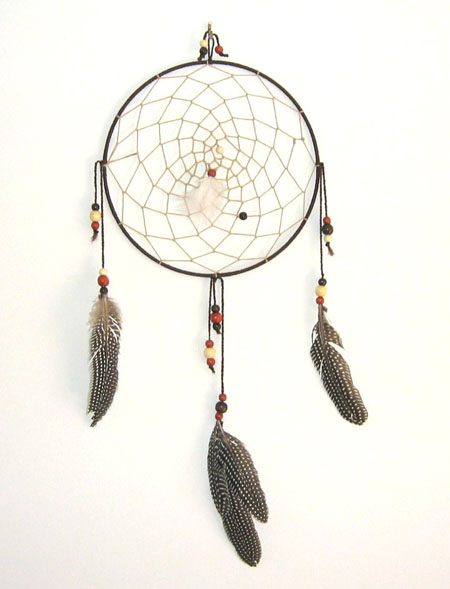

Real Dream Catcher
| INDIAN MAIDEN with FISH |
$108.00 with FREE Shipping |
Indian Maiden with Fish in left hand and Moon over Sun in her right hand. The fish bead is carved from polished bone and symbolizes resourcefulness and plentitude. Each bead swivels freely on the hemp cords hanging from her hands. She has a beautiful violet, gold and ivory acrylic bead head. |
Large Dream Catchers Native American
In Stock: 4
Sky Dance dream catchers in love, sharing the view. MEDICINE MAN and INDIAN MAIDEN as LOVERS Or any two of the above $108 Sky Dancers in any combination - Mix or Match - for $199.00: email us your 2 choices at paleoart@centurylink.net after purchase. |
Sky Dance dream catchers co-emerging face-to-face. |
The ultimate Dream Catcher... Hang in gentle breeze and watch them sky dance.
Real Dream Catcher Near Me
*There are three stages of dream flying: The first is prone-body flying just a foot or two above the ground. As children, many of us have experienced that. Second, one flies to tree-top heights either prone or seated but can’t stay aloft for long. Lastly, one flies standing upright and can traverse the heavens and has transcendent powers. With the latter, upon waking, the soles of ones feet may sometimes feel hot. Perhaps this is a spill-over primal memory when our ancestors walked the hot savannas and looked to the sky at birds, wishing they could fly. Or perhaps feet have a memory of their own of all the walking we have done in lifetimes past since dreaming is a primal activity.
Dream Catchers Real Estate
Next Page: Goddess worship and Love in the Stone Age